

The second coming
Quinton de Kock is in his second spell as a Proteas player

Clinical. That was the word of the day. The Proteas discussed it before the match and kept it on their lips as they went into the contest against Pakistan. Coming into the series, there had been questions around Quinton de Kock. Was he in the right mental space? Did he have enough match preparation? Was his technique right?
De Kock answered those questions and others with a clinical match-winning century. AB de Villiers, who made a 40-ball 30, had a front row seat for 58 minutes to watch the left-hander work his magic. When he spoke to the press after South Africa’s win over Pakistan, De Villiers described De Kock, who had just played his ninth ODI, as a serious talent of the future.
Thirteen years or 4674 days later, De Kock registered his second century against Pakistan in ODIs. And as he did when he as a precocious 20-year-old, he was clinical.
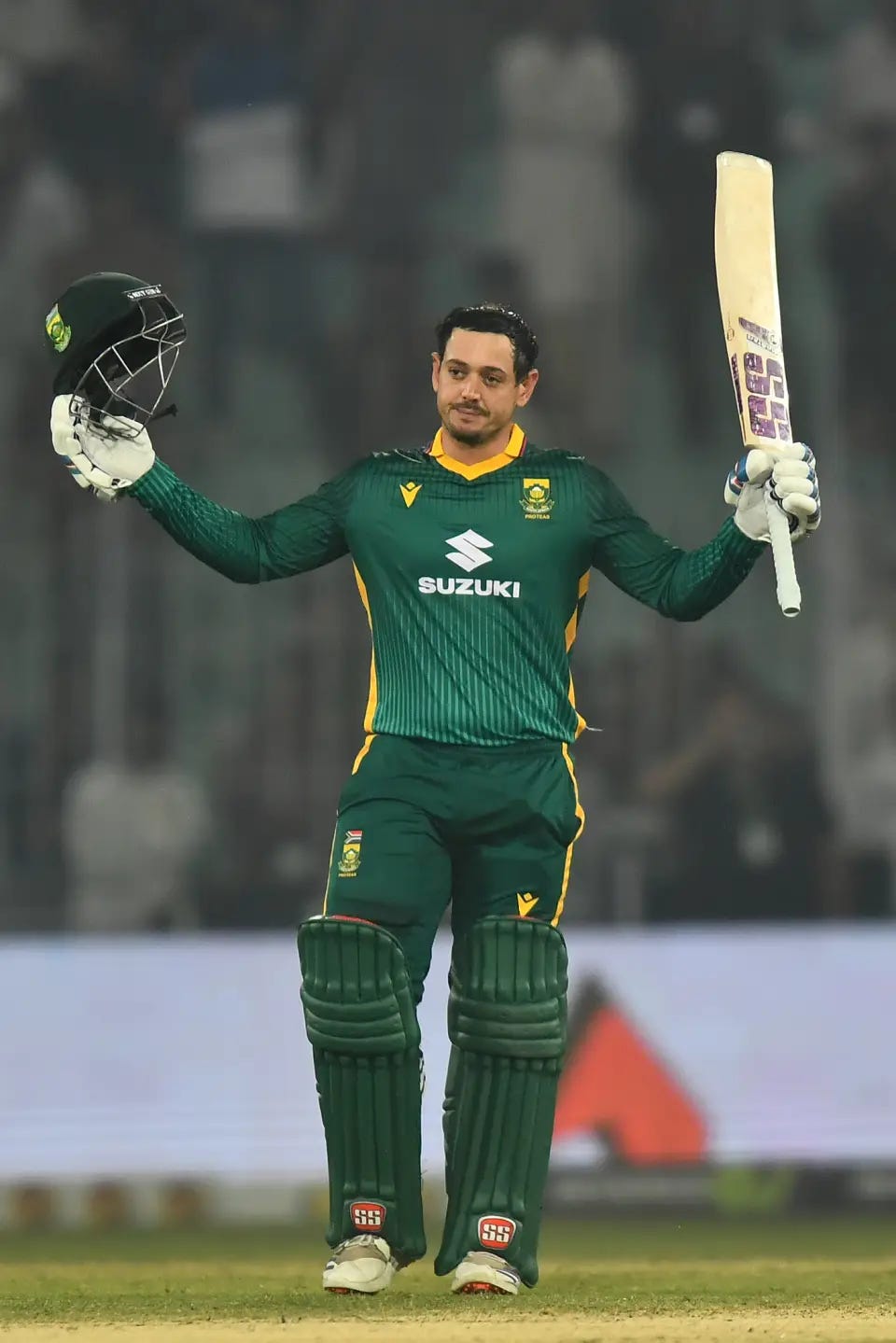
Junior cricketers are taught to acknowledge and salute their teammates and the applauding crowd when they pass a milestone. De Kock never developed a celebration beyond that. In 2013, while De Villiers expressed his joy at the fullest after the De Kock’s maiden ODI century, the left-hander only removed his helmet and raised his bat. That was still his celebration 12 years later.
However, this was not the same player. A lot has happened for De Kock to be the same cricketer he was over a decade ago. The most important being his retirement.
According to Floyd Patterson the first five seconds after you’re knocked out in a boxing match are not a bad feeling.
Patterson was a great boxer. He was a three-time world heavyweight champion, but he will always be remembered for being knocked out by Sonny Liston in the first round in 1962. Up until his death in 2006, that was the one thing he was constantly asked about.
“It’s not painful, just a sharp grogginess. You don’t see angels or start; you’re on a pleasant cloud. After Liston hit me in Nevada, I felt, for about four or five seconds, that everybody in the arena was actually in the ring with me, circled around me like a family, and you feel warmth toward all the people in the arena after you’re knocked out. You feel lovable to all the people. And you want to reach out and kiss everybody—men and women—and after the Liston fight, somebody told me I actually blew a kiss to the crowd from the ring. I don’t remember that,” he told a reporter in the ‘80s.
“But then,” Patterson went on, “this good feeling leaves you. You realize where you are, and what you’re doing there, and what has just happened to you. And what follows is a hurt, a confused hurt—not a physical hurt—it’s a hurt combined with anger; it’s a what-will-people-think hurt; it’s an ashamed-of-my-own-ability hurt. . . . And all you want then is a hatch door in the middle of the ring—a hatch door that will open and let you fall through and land in your dressing room instead of having to get out of the ring and face those people. The worst thing about losing is having to walk out of the ring and face those people. . . .”
I am not sure if De Kock felt the warmth described by Patterson, but I am certain that he felt the hurt. Three moments, the loss to New Zealand in 2015, the semi-final defeat of the 2023 World Cup against Australia and last year’s T20 World Cup final were particularly brutal. De Kock told Tinus van Staden that those incidents broke him down mentally in an interview.
“It left me exhausted. It made me feel like I didn’t know if I could still represent this country. It took too much out of me,” the left-hander shared.
De Kock said that sometimes he would lie awake at night thinking about where he had failed, where he could have done better.
“It would haunt you. It would paralyze me for weeks, sometimes months,” he explained.
Patterson did not take the loss to Liston well. He withdrew from his family and dedicated most of his time towards a rematch. De Kock chose a different path, he drew closer to his family and withdrew from international cricket.
De Villiers described De Kock as a star for the future after the left-hander scored his maiden century. The opener lived up to the legend’s prediction. He scored the most runs for South Africa by a wicket-keeper between his debut, in 2013, and his first retirement in 2023.
He scored 21 centuries and 30 half-centuries on his way to 6767 runs in 154 innings at an average of 46 and a strike rate of 96.6. Those metrics are leagues ahead of every other wicketkeeper who has worn the gloves for South Africa in ODIs. Mark Boucher, who featured in 289 innings, is in second place with 4517 at an average of 28.58.
When you zoom out and compare him to other wicketkeepers in ODI cricket during his first spell with South Africa, De Kock stands head and shoulders above the rest. No other wicketkeeper scored 5000 runs or more. Jos Buttler and Shai Hope, who made their debuts in 2013 and 2016, are in second and third place with 4961 and 4905, in the same period. Only Buttler, who had a strike rate of 117, had a superior strike rate to De Kock’s 96.7.
He placed his name alongside legends that include Jacques Kallis, AB de Villiers, Hashim Amla, Herschelle Gibbs, Graeme Smith, and Gary Kirsten on the list of South African batters with 6000 or more runs for South Africa in ODIs.
One could argue that had De Kock not walked away when he did, he might have ballooned his run tally to a figure close to 8000 runs and a spot in an elite group. But De Kock has no regrets about missing two years of the format.
“I feel like coming back now. I’ve come back with a newfound energy that I think I lost over time playing so much international cricket all the time,” De Kock shared.
De Kock might never get to 8000 ODI runs, but his legacy in the format is intact. The left-hander wears a different hat in his second coming for the Proteas in 50-over cricket. He is older and wiser, and is now part of the cohort that is hand-holding South Africa’s future stars. He is doing for them what De Villiers and others did for him when he scored his maiden ODI ton.
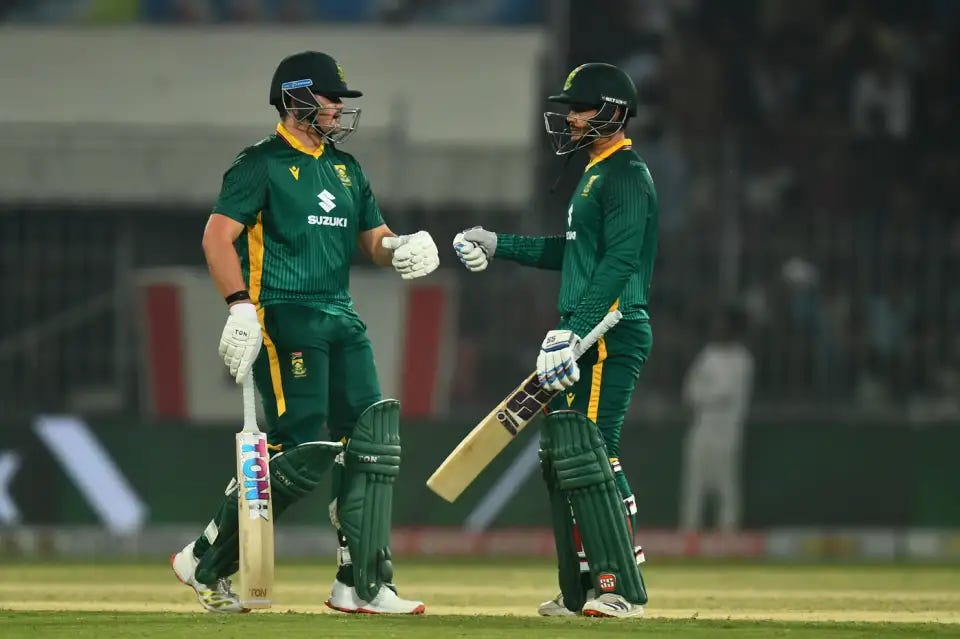
“It [batting with De Kock] was quite cool because I remember when I was 14 at KES, he was playing on the opposite field against [Hoërskool] Waterkloof. I never thought I’d be batting with him for South Africa. So, it was quite a cool moment, which I only kind of clocked afterwards,” said Tony De Zorzi.
A much younger member of the Proteas’ team, Lhuan-dre Pretorius, was only seven when De Kock registered his maiden ODI ton. He looked up to De Kock from an early age and was living his dream batting with the veteran.
“He really calmed me down, I was very nervous. I’ve always said I’ve looked up to Quinny since I could remember. It’s truly a dream come true,” Pretorius shared.
However, De Kock isn’t just experience and guiding words to the younger guys. According to our Good Areas algorithm, De Kock had a true average of 11 and a true strike rate of 18 in ODIs between 2013 and 2023. While the algorithm cannot provide true averages and strike rates from small sample sizes, it can provide us with impact values.
De Kock, who scored a match-winning unbeaten 123 in his second ODI since his comeback, had an impact of 52. That is elite. The century came on the back of a half-century, a 103-ball 63, in his first ODI outing. These figures show that De Kock is still as good as he was in ODI cricket before he left. Just older and wiser.
“When I was out there with Tony, he did most of the batting. We said let’s be as clinical as possible, and don’t even think about letting them back into the game. Unfortunately he got a ball that bounced a bit and got out. I had the same conversation with Matty [Breetzke] - just be professional here, just finish this off clinically,” De Kock said.
He is to this generation what De Villiers was to him when he was 20.