

Grit, Guts, and Glory
Some captains burn everything to the ground when they leave, others choose a different path

Ben Stokes channeled his inner Samson. The former England Test captain brought the walls down on the House of Bazball in his last Test. His final innings was a microcosm of Stokes’ career: his talent was obvious, but he chose volatility. Stokes played for the team in some instances, but he chose to play for gallery most of the time. He was the main character in English cricket.
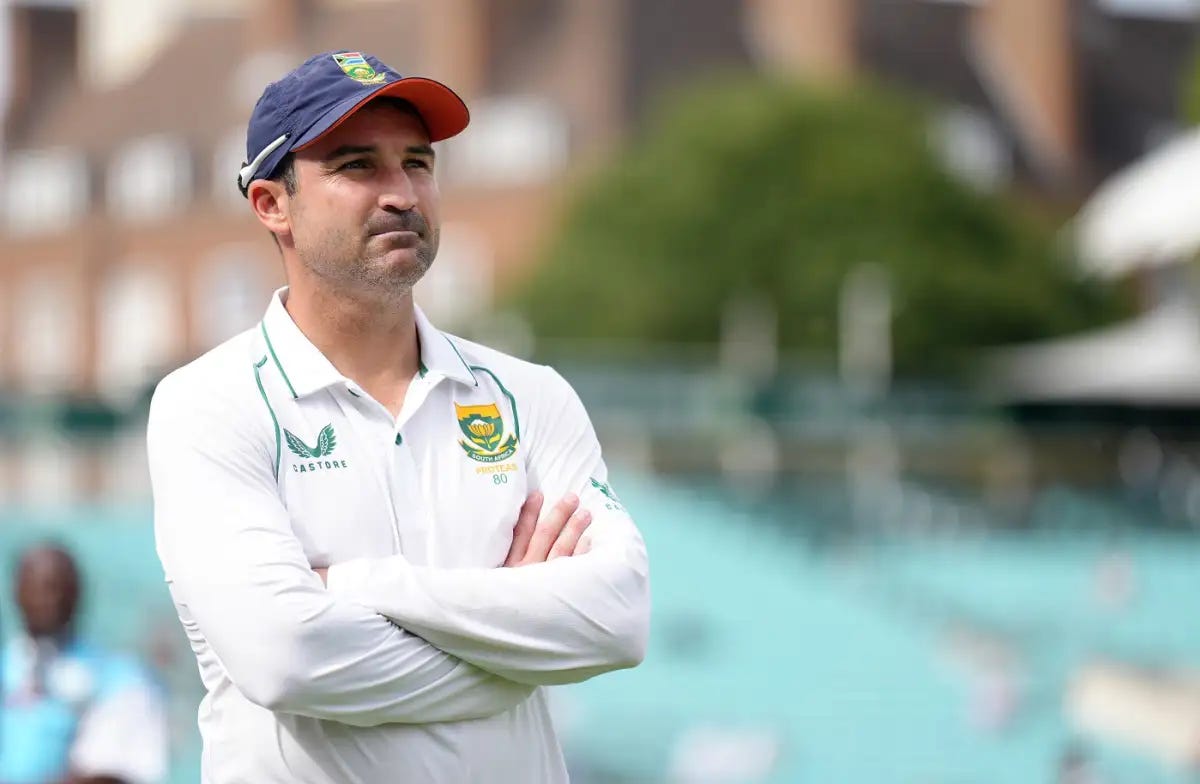
It got me thinking of one of South Africa’s less talked about former captains, Dean Elgar. The lefthander celebrated Aiden Markram’s third innings century as if it was his in his final Test. Elgar operated with a different philosophy to Stokes. The team came first. He understood that his duty was to serve the team. Below, I share a piece that I did for Nightwatchman in 2024.
This article is brought to you by Beyond a Boundary’s generous patrons and gracious coffee buyers.
Pierre Joubert jumped off his feet the moment Dean Elgar’s bat made contact with the ball. He knew the same way he had known two days before the first day of South Africa’s first Test against India at Supersport Park in Centurion.
“As I watched him walk out of my office, I had a feeling that he was going to score big,” said Joubert, the Titans’ Commercial Manager and ex-captain.
Days before the Test, Joubert had asked Elgar to come through for a chat. The Titans had decided to give him a suite to accommodate his friends and family for his final Test at his home ground. A grateful Dean Elgar had promised Joubert that he was going to put on a show for his guests.
Louis Klopper was one of those guests. The 69-year-old coach was beaming with joy. Elgar is like a son to him. He enjoyed a close decades-long friendship with Elgar’s father, Richard. As a youngster, Elgar and Henry, Klopper’s son, spent so much time together they could have been joined at the hip. They were in the same classes, played together after school and played for the same cricket team.
“Dean was a special person, he wanted to practise and play cricket all the time. He was always pushing me for extra hours so much that he took over my Saturdays. We had two-hour sessions on Saturday mornings and afternoons,” says Klopper, who was Elgar’s coach at St. Dominic’s High School and the Free State provincial representative teams from the time he was 11 until he joined the national academy at 18.
“My life was a never-ending, non-stop innings. My father never said no to helping me with my training. If I said to him, let’s go to the nets at three o’clock, he would work through lunch, so we could go to the nets at three o’clock. And then when I’m done, I’d go and join the club side and train there. Instead of going to church, we spent three to four hours in the nets on Sunday morning,” says Elgar.
Elgar had the talent, but it was his belief in his destiny that drew people in. Predicting who will make it in cricket is inherently hazardous and the younger the player is, the harder it is. A lot can go wrong as the player develops. But Klopper had no doubt in his mind when he told Richard of Elgar’s prospects in 1998.
“Richard was visiting at my home. Dean and Henry were playing in the pool when I told Richard that when Dean plays at Lord’s I want to be there, watching live,” says Louis Klopper.
The prophecy came true in 2017. Elgar wasn’t just part of the South Africa side that played against England at Lord’s, he was also the captain, albeit, stand-in captain after Faf du Plessis flew home for his child’s birth. Elgar scored a half-century in that match. Klopper and Richard Elgar were in the stands. As grand as that occasion was for all parties present, it did not equal witnessing Elgar’s last Test knock at Supersport Park.
Watching Elgar dominate the Indian bowlers, Klopper was transported to the past. “When he went out to bat, he always said, ‘Sir, I will win this game for you.’ And he won a lot of games for me at St. Dominic’s and Free State. The bulk of his 79 fifties and 50 centuries were match-winning knocks.”
Everyone in the suite rose, in unison, as the ball raced in front of square. It was an imperious pull. With that shot, Elgar joined an exclusive club. He became the second South African batter after Herschelle Gibbs to score a century on all seven of the home grounds where South Africa played Tests during his career: St George’s Park, Kingsmead, Newlands, Potchefstroom, Bloemfontein, the Wanderers and Centurion. It is also more than likely that Elgar will be the last to do so.
Elgar’s century marked the end of an era, and it is fitting that he was on stage for the curtain call.


Elgar had a nightmare on the field on his debut. He faced 16 deliveries from Mitchell Johnson, couldn’t get the ball off the square and was dismissed for a duck in both innings. That became immaterial the moment Dale Steyn dismissed Nathan Lyon to win the match and the series.
Many professional cricketers play the game with a cold, business-like intent, a focus on the plunder of numbers; Elgar doesn’t. He rates his unbeaten 96 against India at Johannesburg in 2022 higher than the 160 he scored against India in India in 2019 or his brilliant 127 against Australia at Perth.
Elgar is a product of the old school. On his first day with the Eagles (now Free State Knights), his captain, Nicky Boje, welcomed the 18-year-old Elgar with a speech that can be distilled into five words, ‘fit in or bugger off.’ He was there to serve the team, not the other way round.
The speech didn’t make sense immediately, but things grew clearer as the season wore on. He was chastised for personal milestones at the expense of the team’s chances for victory and was praised for fielding exploits that turned the game, even though he did not do well with the bat.
“I play this game to influence the outcome. If you score big and don’t win, for me it’s kind of pointless. Rather get a low score and lose than get a high score and lose. At the end of the day, it’s about winning, it’s about putting the team first. I’d rather sacrifice personal performance to winning, I would rather win a game or a series than have personal accolades. For me, personal accolades are not spoken of. But winning is spoken of,” says Elgar.
His debut got even better when Ricky Ponting and the rest of the Australian team joined the South African team in the changing room for post-match drinks. Elgar developed goosebumps as he listened to Ponting give his final speech as a Test cricketer. The former Australian captain applauded Graeme Smith and his men. They were the toughest opponents he had played against.
“He cried in the final meeting. I was sitting there thinking, ‘This is a legend of world cricket, not Australian cricket, world cricket, and I’ve experienced his last Test. I was like, this is my first Test, things can’t be better than this,’” says Elgar.
And he was right, things did not get better than that night in Perth. From December 2012 to 2016, the period in which South Africa had the Test cricket mace, many from the golden generation retired, and with their retirement, South Africa’s batting powers waned.
In 2012, South Africa averaged 47.36 runs per wicket. In 2016, they were averaging 34.47. During that period, however, Elgar showed himself to be a worthy replacement for Graeme Smith at the top of the order. He was both the fourth-highest run-scorer and had the fourth-highest average among players who batted in 30 or more innings. He also scored the joint second-highest number of centuries for South Africa.
The Elgarhythm: Dean Elgar's Way

“I have a hell of a lot to give, whether it's the Titans, whether it's the Proteas, I got a lot to give. Hopefully, I'll still have a few years left,” Dean Elgar told Derek Alberts when they sat down for the Inside The Game Podcast.
In 2017, South African cricket was faced with a different problem. The CSA board room was captured, to use a South African phrase. Thabang Moroe and Chris Nenzani performed a coup that led the organisation on the path to ruin. During Moroe’s reign as Vice President and Acting CEO of the organisation, Cricket South Africa lurched from one crisis to another.
After realising that CSA could not depend on India’s tours to South Africa to replenish their coffers, the then CSA CEO Haroon Lorgat decided to create a T20 league. Much like the present SA20 league, Lorgat’s T20 Global League was backed by Indian sponsors and potential team owners. That vision suffered a stillbirth.
Moroe and his new team upset CSA’s organisational structure and operations as they consolidated their hold on the board. The potential financiers jumped ship. They couldn’t invest in a turbulent situation.
Not only did CSA have to pay back team owners their deposits, but they also had to pay settlement fees afterwards. The organisation had spent millions of Rands planning and putting together the league. Moroe was burning through money at a faster rate than Cricket South Africa took to make it. In September 2022, Cricket South Africa was on the brink of insolvency.
Up until the arrival of SA20, 80% of Cricket South Africa’s revenue was off the back of the Proteas, South Africa’s men’s team. A large chunk of it came from hosting India and a smaller chunk came from sponsorships. Things came to a head in 2019 when the infamous Fundudzi Report was released and laid bare the wasteful expenditure and the crisis of mistrust between Cricket South Africa and the players.
Between the 6th and 4th centuries BC, other Greeks commonly accepted that ‘one Spartan was worth several men of any other state.’ Lycurgus, the founder of the iconic army, referred to Sparta as having a ‘wall of men, instead of bricks.’ Throughout his international career, Dean Elgar was the embodiment of Lycurgus’ Spartan warrior.
There is no better example of that than his 136 against England at the Oval. Elgar spent more than five and half hours at the crease batting with a broken finger for his 136. The rest of the South African line-up combined to put together 101 runs. His knock made South Africa’s innings look respectable and by extension, he helped sanitise South African cricket’s image.
It was in this era, the second phase of his international career, where that he carried his the bat twice to equal Desmond Haynes’ record. Like Haynes, Elgar carried his bat three times in Test cricket. He was South Africa’s highest run-scorer from January 2017 to December 2020 and averaged 40.88, the highest average by far among players with 30 or more innings.
Elgar carried the Test team on his shoulders. He played the most matches, was the most consistent, and scored the most 100s and second-most 50s. He gave his team and the fans something to cheer.

Dean Elgar was not supposed to play a farewell Test at home. He was supposed to simply vanish from the game. A sad end to the career of a loyal servant and former captain. Elgar was appointed captain of South Africa’s Test team in 2021, at the beginning of the third phase of his career. Graeme Smith was rebuilding the administrative side and Elgar was tasked with rebuilding the team.
“When I started playing in the Proteas set-up there was the legends of South African and world cricket playing in that side. Your responsibility as a player was looked after by them. They allowed you to come in and learn your game, and get used to the style of play of what international cricket demands.
“Whereas now we don’t have those experienced guys, we have young guys who have been selected on the back of playing a few seasons of first-class cricket, and that’s not their fault. It’s purely because we’ve lost so many players along our journey at quite a rapid rate,” Elgar shared with me a few months after he assumed the captaincy.
During his tenure, South Africa won five Tests, lost four and drew one. When they were winning, he was cautiously optimistic in the dressing-room and did his best to prepare his team for the worst days when they might lose by big margins.
“Captaincy is about worrying about everyone else and making sure they are in a good frame of mind. Dean is good at that,” says Joubert.
The bad series came against Australia in December 2022. Then he was sacked as captain. Shukri Conrad was appointed as head coach and he had wanted to steer the team in a different direction. Elgar didn’t feel as if he had accomplished what he had set out to do as captain, but he was happy to step aside. Conrad had his reasons and Elgar was sure he could still add value as a senior member of the team.
“You can either be very selfish in this environment or you can be a giver. For me, the question is, are you taking oxygen or are you giving oxygen?” says Elgar.
“When I first saw him play, it was against us. He scored 200 against us,” says Joubert. “He scored 60 to 80 of his runs behind square and down to third man, and he also scored some ugly runs, edges and mis-hits, all that didn’t bother him. There was no ego about him.”
Before the match, Boeta Dippenaar, the Eagles captain, had shared with Joubert his belief that Elgar was the only one in his team likely to have a great career with the national team. After watching the youngster compile his innings, it all made sense to the visiting captain. It wasn’t so much that Elgar had a solid technique, but his ability to keep his attacking instincts in check.
South African pitches are a weird hybrid of Australian, West Indian, English and New Zealand pitches. They are treacherous for openers. To be successful as an opener in red-ball cricket, one you needs to be comfortable shelving 70% of your their skill and technique and falling back on the other 30%, which is what Elgar did.
“I have heard commentators talk about how Dean doesn’t have good technique, it’s rubbish. He played the way he did because he had to do so for the team,” says Klopper.
Klopper has seen a different side of Elgar. As a teen, Elgar attacked from the first ball. His father, Richard, fondly remembers a match where the then-14-year-old Dean Elgar single-handedly chased down a score of just over 200 set by Noord Kaap, a Kimberly-based outfit that boasted a few Griqua (now Northern Cape) players. Elgar took down older, bigger and stronger bowlers as he scored an imperious 130.
Joubert agrees with Klopper’s assessment. “People underestimate the number of times he made the new ball old without making runs,” he says.
Klopper, Joubert and Elgar agree on something else: in professional cricket, you are always warming the seat for the next guy the way your predecessor warmed it while waiting for your arrival.
What Elgar didn’t understand was Conrad’s decision to leave him out of South Africa’s next two Test series. South Africa needed their strongest batting 11 to prevent India from ‘conquering the final frontier’, and in New Zealand, South Africa needed all the experience and skill to keep another record intact.
But, if there is one thing South African cricketers have come to terms with it is that selection decisions do not make sense.
In December 2022, Theunis de Bruyn shared with me that while he was happy at another opportunity to represent South Africa after he was selected for South Africa’s tour to Australia, he didn’t understand how it had come about. He hadn’t had a great domestic season in the lead-up to the selection. But most selection decisions do not make sense in South African cricket, anyway.
The best Elgar could do was beg Conrad for a final series at home and an opportunity to bid farewell to the home crowds he had selflessly served over the years. A sad end to a career for one of South Africa’s best openers. Elgar was South Africa’s leading run-scorer in Tests over a six-year period, he is the fourth-highest opener in the history of South African openers and the leading opener at home.
His plea was granted and he signed off in style. With a history-making century. South African cricket will not witness another red- ball opener like Dean Elgar again. Neither will any other opener feature in 86 Tests like him. This is the end of an era.
Beyond a Boundary is a reader-supported publication. It is powered by our Patrons and the generous coffee buyers. It’s been a little cold and the coffees will go a long way in keeping my fingers thawed.
Thank you to everyone for your time and for your support of Beyond a Boundary over these five years! And thank you for helping spread the word about this corner of the cricket space to all your family, friends, and social networks! Word of mouth is a huge, huge part of what can help Beyond a Boundary to keep growing and going along.