

A star is born
Jason Rowles is now one of two South African players with a double century in YTests

Beyond a Boundary is a reader-supported newsletter. This article is brought to you by our generous patrons and gracious coffee buyers. Please consider being part of a group of people that makes this content possible.
Jason Rowles didn’t always have someone to play with or throw balls at him when he was young. So he devised a game. He planted cones in the backyard. Each represented a fielder. Rowles’ positions were taken from the tactics he had watched teams employ on TV.
Then he would bounce the ball off the wall and try to guide the it into the gaps. He threw the ball into the wall at different heights and angles to make his one-man game challenging. Hours flew by and he wouldn’t notice. When his parents switched the lights on late in the day, he would convert his match into a day-night encounter.
His game was a practice in placement; he tried to thread shots between cones. However, he never got tied down to batting to the same ‘field’ because he watched so much cricket.
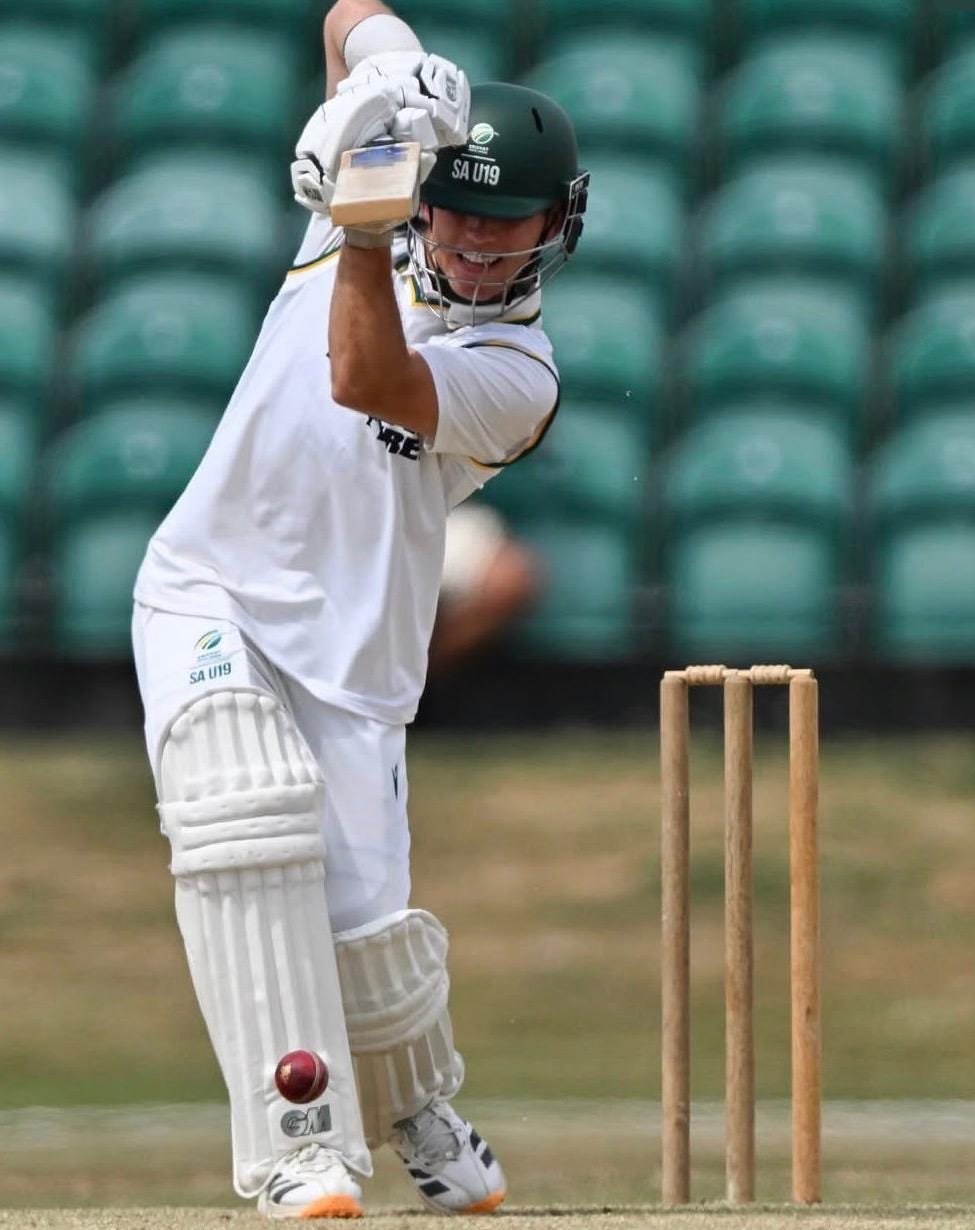
Ralphie Albert and Ali Farooq didn’t know this back story when they had a conference after lunch on day two of the second Youth Test between England u19 and SA u19 at the Sussex County Ground. But they had seen enough of him in the first two days to guess where he would struggle to play the ball. Rowles was on 199 and they wanted to stop him from getting the single that took him to 200.
Albert, the England u19 captain, made a couple of field changes as directed by his spinner. They closed one gap and opened another. Rowles nudged Farooq’s delivery into a vacant space on the leg side and took two runs. With that, he helped South Africa reach 400 runs. He also became the second South African player to reach a double century in YTests.
Grant Elliot was the first to do it in December 1997. He made an unbeaten 201 from 291 balls. Rowles got there in 294.
***
You were guaranteed to see one of two things when you tuned into the Sussex Cricket YouTube channel on day one: Rowles’ number 49 shirt staring at you or Joshua van Biljon’s 11. Van Biljon, who was in at first drop, walked out to the crease in the first over, following Mohammed Bulbulia’s early exit.
The surface was doing a bit and required the batters to knuckle down. Van Biljon and Jorich van Schalkwyk did so with a 59-run second-wicket stand off 149 balls. The wicket-keeper was a study in patience. After Van Schalkwyk’s dismissal, Van Biljon added 49 runs from 123 balls in his 112-run third-wicket partnership with Rowles.
He didn’t just take the shine from the new ball, he also took the spring out of the England bowlers, who were spent by the time the wicket-keeper walked back to the crease after a long shift. Van Biljon faced 203 deliveries in 257 minutes for his well-constructed 72 runs.
Rowles built his innings on the back of two his third-wicket partnership with Van Biljon and then his fifth-wicket stand with Bandile Mbatha. Between them, Van Biljon and Mbatha faced 71 overs. Van Biljon kept Rowles company as he compiled his first 62 runs. Mbatha was with him for the rest of his 107 runs. Like Van Biljon, Mbatha was content to drop his anchor and keep one end secure. The all-rounder stonewalled his way to a 223-ball 81.
***
Mumbai is a hot and humid place, especially in the summer. Temperatures hover around the mid 30s and rise to 38 on the hottest days. Rowles was 16 when he first visited Bengaluru and it was in the middle of summer. He had gone there on Dinesh Lad’s invitation. The Indian coaching maestro is viewed as one of India’s foremost talent whisperers. His extensive CV that features people like Rohit Sharma and Shardul Thakur among his students.
Lad watched a few clips of Rowles, was convinced of the youngster’s talent and invited the youngster to India for a few sessions. The youngster changed shirts twice each afternoon during training. However, the heat and humidity didn’t seem to have an effect on Rowles. He turned up looking energetic each morning and remained engaged throughout the 6-hour session.
He needed that level of endurance in his 411-minute marathon innings. Rowles looked unaffected by the long period he spent in the middle. If we break his double century into four blocks of 50 runs, we notice that his first 50 was the slowest and probably his hardest. He faced 101 runs to get to 50. The second one was the quickest and came off 54 deliveries, while the third and fourth came off 76 and 62 balls, respectively.
Rowles had 32.2 overs under his belt at the close of day one. He was on 123 from 194. It is hard to know whether he was aware or not, but he was two runs short of his highest score for SA u19, an unbeaten 125 against Tanzania in an u19 World Cup match. His first port of call on the second day was to get over that mark. He did so on the sixth ball he faced the next morning.
After getting over that milestone, another landmark came into view for the left-hander. Before the YTest, only four there were only four SA u19 players with 150 runs or more: Reeza Hendricks, Faf du Plessis, Morne van Wyk, and Grant Elliot. It took him 232 balls join the club. From then onwards, he was climbing the ladder to the top of that list.
He faced 10 deliveries to go from 150 and surpass Hendricks’ marker. The Proteas star made 156 from 263 in 2007. Rowles went past Hendricks in style, he lofted a wide delivery from Albert over cover for a six. The shot also brought up his 100-run partnership with Mbatha. The stroke brought Faf du Plessis’ milestone into view.
The former Proteas captain and T20 star put the England u19 bowlers to the sword as he compiled 177 runs from 244 balls at Chelmsford in 2003. His innings lifted SA u19 to 646/9d and set them up for an emphatic victory by an innings and 163 runs. Rowles needed 262 deliveries to equal Du Plessis’ tally.
The Gert van Rensburg Stadium in Fochville has not seen a cricket match in years. Not even a club match. It sits in disrepair. It has been in that state for years. The forgotten venue was the site of Morne van Wyk’s 188 in a match where five of their players got starts and failed to convert, and two others, Johann Myburgh and Gulam Bodi made 64 and 69 runs.
Rowles unfurled a lovely cover drive to match Van Wyk’s total 12 balls after equaling Du Plessis’ tally. He now needed only 13 runs to get to the top of the ladder. Those 13 runs came off a further 20 deliveries.
“l told him last this might be his last innings, so, he must go big,” Bongani Ntini, Rowles’ long time coach, shared.
The two spoke after the first day of action. Rowles listened to his coach and went big.
Majola started it, Basson finished it

Beyond a Boundary is a reader-supported newsletter. This article is brought to you by our generous patrons and gracious coffee buyers. Please consider being part of a group of people that makes this content possible.
Beyond a Boundary is a reader-supported publication. It is powered by our Patrons and the generous coffee buyers. It’s been a little cold and the coffees will go a long way in keeping my fingers thawed.
Thank you to everyone for your time and for your support of Beyond a Boundary over these five years! And thank you for helping spread the word about this corner of the cricket space to all your family, friends, and social networks! Word of mouth is a huge, huge part of what can help Beyond a Boundary to keep growing and going along.